NSA Codebreaker 2025 - Task 4: Unpacking Insight
Understanding an obfuscated Linux sample
On this page
Once back at NSA the team contacts the NSA liaison at FBI to see if they have any information about what was discovered in the configuration data. FBI informs us that the facility registered to host that domain is on a watchlist for suspected criminal activity. With this tip, the FBI acquires a warrant and raids the location. Inside the facility, the server is discovered along with a suspect. The suspect is known to the FBI as a low-level malware actor. During questioning, they disclose that they are providing a service to host malware for various cybercrime groups, but recently they were contacted by a much more secretive and sophisticated customer. While they don’t appear to know anything about who is paying for the service, they provide the FBI with the malware that was hosted.
Back at NSA, you are provided with a copy of the file. There is a lot of high level interest in uncovering who facilitated this attack. The file appears to be obfuscated.
You are tasked to work on de-obfuscating the file and report back to the team.
Downloads
- obfuscated file (
suspicious)
Task
Submit the file path the malware uses to write a file.
Writeup
Initial file identification revealed the given sample to be a 64-bit Linux executable:
$ file suspicious
suspicious: ELF 64-bit LSB pie executable, x86-64, version 1 (SYSV),
dynamically linked, interpreter /lib64/ld-linux-x86-64.so.2,
BuildID[sha1]=3fc9729b05add2cba0bddd498f66c8b497060343,
for GNU/Linux 3.2.0, stripped
The binary was stripped, removing symbol information and making our static analysis a bit more challenging.
Entropy Analysis
To identify potential obfuscation or packing, I performed entropy analysis on the binary using ImHex. The entropy graph revealed several sections with notably high entropy (approaching 1.0), indicating the presence of encrypted or compressed data:
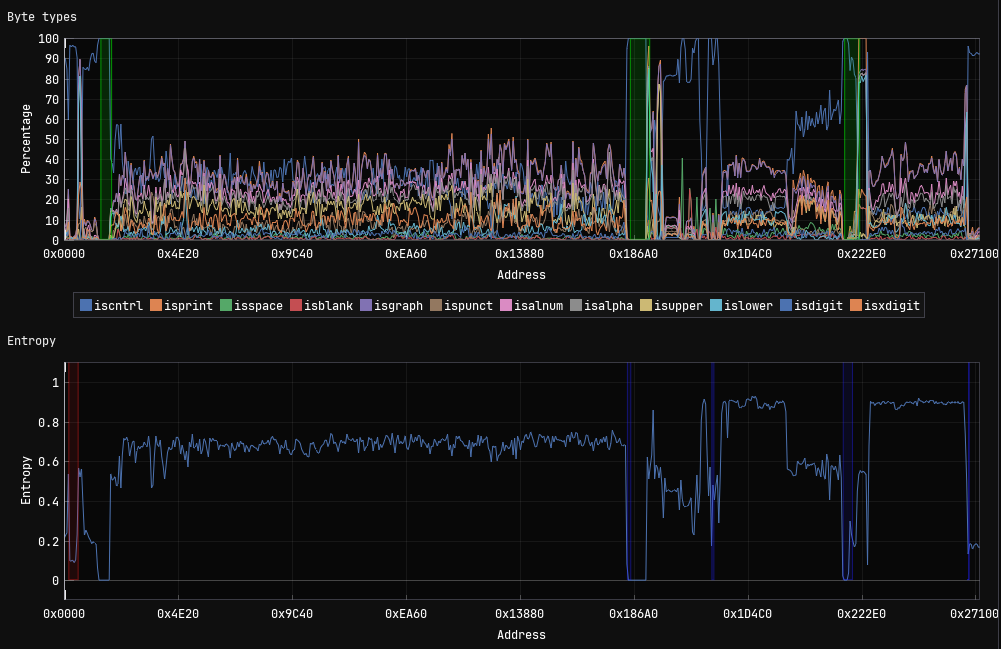
The high entropy sections at addresses 0x186A0, 0x1D4C0, and 0x222E0 suggested the malware contained encrypted payloads that would be unpacked during runtime.
Discovering Anti-Debug Mechanisms
Initial attempts to run the binary under GDB revealed an anti-debugging trap:
$ gdb ./suspicious
(gdb) run
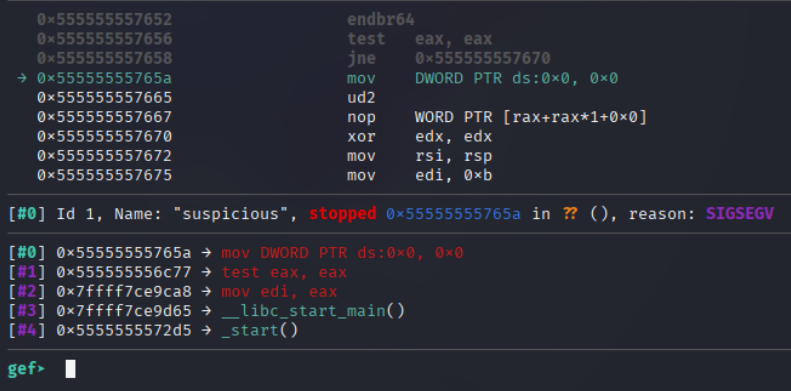
The program immediately crashed with a SIGSEGV (segmentation fault) at address 0x55555555765a. Examining the instruction at this location revealed:
0x55555555765a mov DWORD PTR ds:0x0, 0x0
This instruction attempts to write to NULL (address 0x0), an intentional crash mechanism.
Identifying Additional Anti-Debug Functions
However, simply NOPing out the crash instruction proved insufficient. Through static analysis in IDA, I examined the binary to understand the full anti-debug chain and discovered two additional protection mechanisms that needed to be bypassed.
Mechanism 1: ptrace Detection (sub_3590)
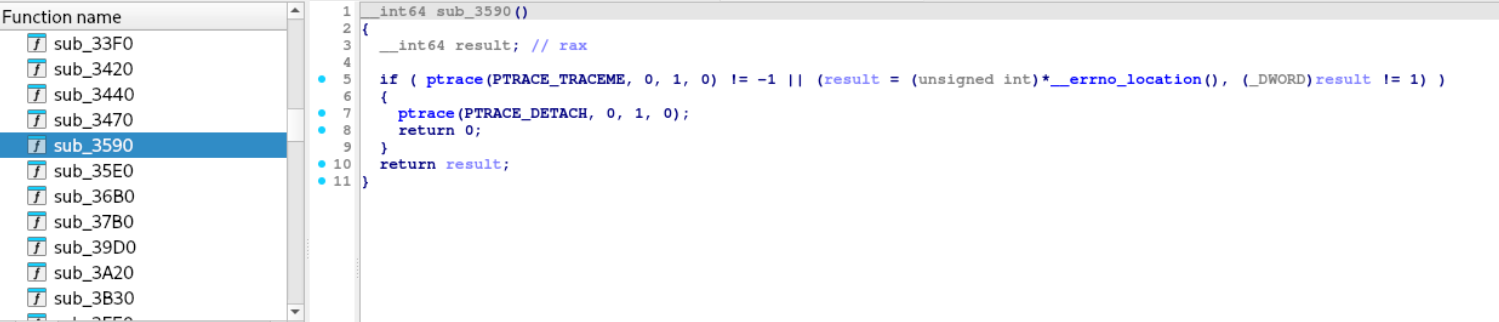
Located at address 0x3590, this function uses ptrace(PTRACE_TRACEME) to detect debugger presence:
__int64 sub_3590()
{
  __int64 result;
  if ( ptrace(PTRACE_TRACEME, 0, 1, 0) != -1 ||
       (result = (unsigned int)*__errno_location(), (_DWORD)result != 1) )
  {
    ptrace(PTRACE_DETACH, 0, 1, 0);
    return 0;  // No debugger
  }
  return result;  // Debugger detected (returns non-zero)
}
When a process is already being traced by a debugger, PTRACE_TRACEME fails with errno = EPERM (1). The function returns a non-zero value if a debugger is detected, which triggers the anti-debug chain.
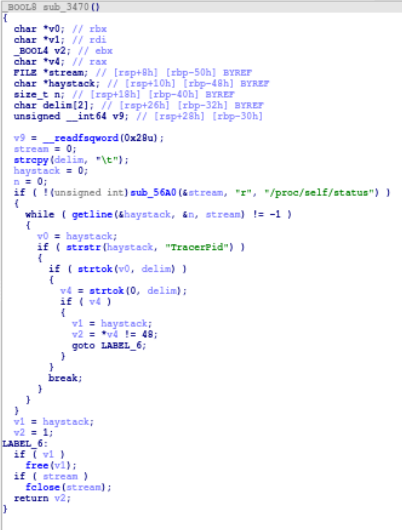
Mechanism 2: TracerPid Check (sub_3470)
Located at address 0x3470, this function reads /proc/self/status to check the TracerPid field:
_BOOL8 sub_3470()
{
  // Opens /proc/self/status
  if ( !(unsigned int)sub_56A0(&stream, "r", "/proc/self/status") )
  {
    while ( getline(&haystack, &n, stream) != -1 )
    {
      if ( strstr(haystack, "TracerPid") )
      {
        if ( strtok(v0, delim) )
        {
          v4 = strtok(0, delim);
          if ( v4 )
          {
            v2 = *v4 != 48;  // Returns true if TracerPid != '0'
            // ...
          }
        }
      }
    }
  }
  return v2;
}
When a debugger is attached, the TracerPid value in /proc/self/status is non-zero (the PID of the debugging process). This function returns true when debugging is detected.
Anti-Debug Bypass
To enable full dynamic analysis, I created a simple Python script to patch all three anti-debug mechanisms:
with open('suspicious', 'rb') as f:
    data = bytearray(f.read())

# Patch sub_3590 (ptrace check) to immediately return 0
offset = 0x3590 + 4  # Skip endbr64 instruction
data[offset:offset+3] = b'\x31\xc0\xc3'  # xor eax, eax; ret

# Patch sub_3470 (TracerPid check) to immediately return 0
offset2 = 0x3474
data[offset2:offset2+3] = b'\x31\xc0\xc3'  # xor eax, eax; ret

# Patch NULL pointer trap at 0x765a
offset3 = 0x765a
data[offset3:offset3+10] = b'\x90' * 10  # NOP sled

with open('suspicious_patched3', 'wb') as f:
    f.write(data)

print("Patched all anti-debug checks")
The patches work by:
- Replacing both detection functions with
xor eax, eax; retto force them to always return 0 (no debugger detected) - NOPing out the NULL pointer trap to prevent the crash
Dynamic Analysis and Payload Extraction
With the anti-debug protections bypassed, I proceeded with dynamic analysis using GDB. Since the challenge specifically asks for “the file path the malware uses to write a file,” I set a catchpoint on the write system call to monitor all write operations:
$ gdb ./suspicious_patched3
(gdb) catch syscall write
Catchpoint 1 (syscall 'write' [1])
(gdb) run
(gdb) continue
Upon the first continue, I hit a write operation. To understand what was being written, I needed to examine the system call arguments. On x86-64 Linux, system calls pass arguments through registers according to the following convention:
rdi= first argumentrsi= second argumentrdx= third argument
For the write system call specifically, the signature is write(int fd, const void *buf, size_t count), which maps to:
rdi= file descriptor (where to write)rsi= buffer pointer (what to write)rdx= byte count (how much to write)
Examining these registers:
(gdb) info registers rdi rsi rdx
rdi            0x3                 0x3
rsi            0x555555590390      0x555555590390
rdx            0xcee8              0xcee8
This revealed the malware was writing to file descriptor 3, with 0xcee8 (52,968) bytes of data from memory address 0x555555590390. The large size suggested this was payload data rather than typical logging output.
To identify what file descriptor 3 represented, I checked the process’s file descriptors while it was paused in the debugger:
(gdb) shell ls -la /proc/$(pgrep suspicious)/fd/
total 0
dr-x------ 2 kali kali  4 Nov 20 21:01 .
dr-xr-xr-x 9 kali kali  0 Nov 20 21:01 ..
lrwx------ 1 kali kali 64 Nov 20 21:01 0 -> /dev/pts/0
lrwx------ 1 kali kali 64 Nov 20 21:01 1 -> /dev/pts/0
lrwx------ 1 kali kali 64 Nov 20 21:01 2 -> /dev/pts/0
lrwx------ 1 kali kali 64 Nov 20 21:01 3 -> '/memfd: (deleted)'
File descriptor 3 pointed to /memfd: (deleted) - a memory-backed file. This technique allows the malware to unpack a payload into memory without writing to disk, avoiding file-based detection. I extracted this data while the program was paused:
(gdb) dump binary memory /tmp/extracted.bin 0x555555590390 0x555555590390+0xcee8
Analyzing the Unpacked Payload
The extracted payload was itself an ELF binary:
$ file /tmp/extracted.bin
/tmp/extracted.bin: ELF 64-bit LSB shared object, x86-64, version 1 (SYSV),
dynamically linked, BuildID[sha1]=69d0667eed34a355fc78fbe68a7eed42897947c1, stripped
Loading this unpacked payload into IDA revealed the true functionality. The payload’s run() function showed an interesting pattern:
unsigned __int64 run()
{
  _BYTE v2[264]; // RC4 state
  v3 = __readfsqword(0x28u);

  sub_7C8E(v2, "skibidi", 7);  // Initialize RC4 with key "skibidi"

  if ( (unsigned __int8)sub_8574(v2) == 1
    && (unsigned __int8)sub_8666(v2) == 1
    && (unsigned __int8)sub_86F8() == 1
    && (unsigned __int8)sub_8771() == 1
    && (unsigned __int8)sub_8795(v2) == 1
    && (unsigned __int8)sub_8A0F(v2) == 1 )
  {
    sub_7F5D(v2);
  }

  return v3 - __readfsqword(0x28u);
}
The function initializes an RC4 cipher state with the key "skibidi" and then calls multiple check functions, each of which decrypts strings using the RC4 state.
RC4 Decryption and File Path Discovery
Each check function followed a similar pattern, calling sub_7EFF (the RC4 decryption routine) with encrypted data:
_BOOL8 __fastcall sub_8574(__int64 a1)
{
  _BYTE v3[32];
  _BYTE v4[40];

  sub_7EFF(v3, &unk_D580, 38, a1);  // Decrypt 38 bytes from 0xD580
  std::filesystem::__cxx11::path::path<std::string>(v4, v3);
  v1 = std::filesystem::exists((std::filesystem *)v4);

  return v1 != 0;
}
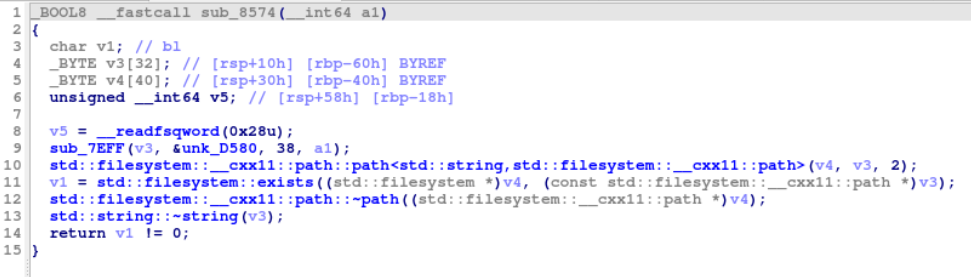
This function decrypts data from address 0xD580 and checks if that path exists on the filesystem. Examining the encrypted data in IDA:
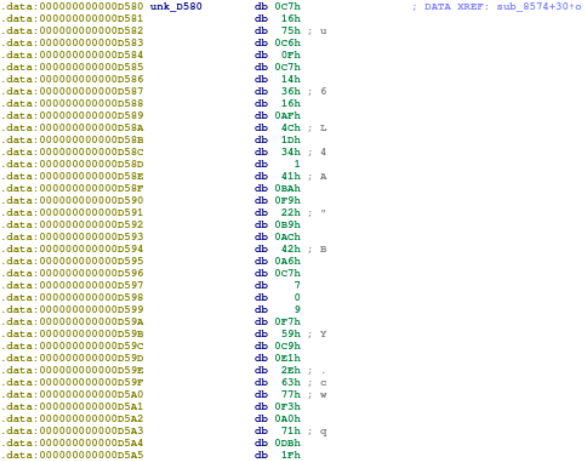
The encrypted bytes at 0xD580 (38 bytes):
C7 16 75 C6 0F C7 14 36 16 AF 4C 1D 34 01 41 BA
F9 22 B9 AC 42 A6 C7 07 00 09 F7 59 C9 E1 2E 63
77 F3 A0 71 DB 1F
To decrypt this, I implemented the following in Python:
def rc4_init(key):
    """RC4 Key Scheduling Algorithm (KSA)"""
    S = list(range(256))
    j = 0

    for i in range(256):
        j = (j + S[i] + key[i % len(key)]) % 256
        S[i], S[j] = S[j], S[i]

    return {'S': S, 'i': 0, 'j': 0}

def rc4_keystream_byte(state):
    """RC4 Pseudo-Random Generation Algorithm (PRGA)"""
    S = state['S']

    state['i'] = (state['i'] + 1) % 256
    state['j'] = (state['j'] + S[state['i']]) % 256

    S[state['i']], S[state['j']] = S[state['j']], S[state['i']]

    return S[(S[state['i']] + S[state['j']]) % 256]

# Key found in malware's run() function at sub_7C8E call
rc4_state = rc4_init(b"skibidi")

# Encrypted data from address 0xD580 (passed to sub_7EFF by sub_8574)
ciphertext = bytes.fromhex('C71675C60FC7143616AF4C1D340141BAF922B9AC42A6C7070009F759C9E12E6377F3A071DB1F')

# RC4 decryption: ciphertext XOR keystream = plaintext
plaintext = bytes([c ^ rc4_keystream_byte(rc4_state) for c in ciphertext])

print(f"Decrypted: {plaintext.decode()}")
# /opt/dafin/intel/ops_brief_redteam.pdf
In RC4’s standard implementation, S represents the state array (a permutation of values 0-255), while i and j are indices used to traverse and manipulate this array. For further reading I highly recommend the Wikipedia page: https://en.wikipedia.org/wiki/RC4.
Running this script revealed the file path the malware uses:
Decrypted file path: /opt/dafin/intel/ops_brief_redteam.pdf

Success! By bypassing multiple anti-debug protections, extracting the memory-mapped payload through dynamic analysis, and reverse engineering the RC4 encryption scheme with the key skibidi I successfully decrypted the hidden file path.